
New York City is one of those places where you could visit a dozen times and still barely scratch the surface.
Most visitors follow the same well-worn path: Times Square, the Empire State Building, Central Park, and the Statue of Liberty. And yes, those places are iconic for a reason.
But some of the most interesting, surprising, and memorable experiences this city has to offer don’t show up on the standard tourist itinerary.
They’re tucked into quiet neighborhoods, hiding in plain sight on famous streets, or sitting just far enough off the beaten path that most people never bother.
These 15 most underrated places in NYC are worth seeking out. Some are free.
Some require a reservation. All of them will give you a side of New York that most visitors never see.

Before You Start Exploring underrated places in NYC
A little planning goes a long way with a list like this. Some of these places require reservations and sell out faster than you might expect.
The Tenement Museum and the Frick Collection are the two where you will most regret showing up without a ticket, so check their websites and book before your trip.
Several others on this list offer free or pay-what-you-wish admission on specific days.
The Frick is free on First Fridays, the Morgan Library is free on Friday evenings, and the Museum at Eldridge Street is free on Mondays and Fridays.
A little timing around those windows can save you real money.
Suppose you can go on a weekday. Most of these spots are noticeably quieter Monday through Thursday, and a few, like Little Island, do not require reservations at all during the week.
Many of these attractions are also close to one another, so it is worth grouping them by neighborhood rather than crisscrossing the city. The Lower East Side alone can fill a rich half day between the Tenement Museum, the Museum at Eldridge Street, and the surrounding streets.
The Upper East Side puts the Frick, the Cooper Hewitt, and the Conservatory Garden all within comfortable walking distance of each other.
The High Line and Little Island connect naturally along the Hudson River for an easy afternoon on the West Side.
New York is a city that rewards people who do a little homework before they go. These 15 underrated places in NYC are proof of that.
1. The Frick Collection
If you haven’t visited the Frick since it reopened in April 2025, put it back on your list immediately.
After a four-year, $220 million renovation, the Frick has returned to its original Fifth Avenue mansion more beautifully restored than ever making it one of the best underrated places in NYC.
This was the private home of industrialist Henry Clay Frick, and it houses one of the finest art collections in the entire country.
Works by Vermeer, Rembrandt, Titian, Goya, El Greco, and Manet hang in room after room, all still feeling more like a private home than a museum.
One of the most exciting changes from the renovation is that the second floor is now open to the public for the first time.

These former private quarters of the Frick family now display rarely seen drawings by Degas, Goya, and Whistler.
Most visitors focus on the famous first-floor galleries and miss this entirely, which is a shame.
There is also a new café on site, which makes for a lovely way to end your visit.
Admission: Adults $30, seniors 65+ $22, students with valid ID $17, visitors with disabilities $22, ages 10 to 18 free. Children under 10 are not admitted.
Pay-what-you-wish admission is available on Wednesdays from 1:30 to 5:30 pm. Free First Friday evenings run from 5:30 to 9:00 pm. Advance timed tickets are required for all other visits. Book at frick.org.
Where to stay in the Upper East Side of New York City.
2. The Lower East Side Tenement Museum
This is one of the most moving and genuinely interesting museums in New York City, and far too many visitors miss it entirely. It is by far one of the most underrated places in NYC.
The museum is housed in a 19th-century tenement building on Orchard Street, and it tells the stories of the immigrant families who lived there through fully recreated apartments, photographs, personal letters, and, in many cases, the recorded voices of the people themselves.
Every tour covers a different family and a different era of immigrant life in New York City.
One of the standout exhibits is Under One Roof, which follows three families: the Jewish Epsteins, the Puerto Rican Velez family, and the Wongs from China, who all lived in the building from the 1940s through the 1980s.

Each apartment is recreated down to the period furniture and personal details. It’s a genuinely remarkable experience.
The museum also runs neighborhood walking tours of the Lower East Side, which are well worth adding on if you have the time.
Admission: $30 per person. Reservations are required, and tours sell out, so book ahead at tenement.org.
Cool hotels in New York City’s Lower East Side.
3. Roosevelt Island
Most New Yorkers have never set foot on Roosevelt Island, which says a lot about how overlooked this place really is.
The island sits in the East River between Manhattan and Queens. You can reach it by subway, bridge, or the Roosevelt Island Tramway, which is the only commuter aerial tram in the United States.
The tram runs on a MetroCard, and the five-minute ride delivers spectacular views of the East River, the 59th Street Bridge, and the Manhattan skyline from a perspective you simply cannot get anywhere else.
The island has a fascinating history. Known as Welfare Island until the 1970s, it was once home to a smallpox hospital, an insane asylum, and various other city institutions.
The ruins of the old smallpox hospital still stand at the southern tip of the island, crumbling and atmospheric.

At the northern end is a lighthouse built in 1872, and the southern tip features a beautiful park dedicated to Franklin Roosevelt.
It is a peaceful, easy half-day trip from the city, and the views alone make it well worth the journey to this, one of the underrated places in NYC.

4. The Conservatory Garden in Central Park
Most people think they know Central Park. Very few make it up to the Conservatory Garden at 105th Street and Fifth Avenue, and that is genuinely their loss.
This formal garden is one of the most beautiful and peaceful spots in all of Manhattan and one of the most underrated places in NYC.
You enter through a set of ornate wrought iron gates that were rescued from the Vanderbilt mansion before it was demolished.
That mansion once stood where Bergdorf Goodman is today on 59th Street and Fifth Avenue. Inside the gates, three distinct gardens unfold: Italian, French, and English, each with its own character and plantings.

Spring is particularly spectacular here, with flowering trees and bulbs in full bloom. But the garden has something to offer in every season, and it is free to enter and open year-round.
It is one of those places that feels like a real discovery, even though they have been there all along.
5. The Morgan Library and Museum
This is one of those places that even many longtime New Yorkers have never discovered, and it sits right in the heart of Midtown, just a short walk from Grand Central Terminal.
The Morgan Library was built for financier J.P. Morgan in the early 1900s and is a masterpiece of Beaux-Arts architecture.
The original library, with its richly decorated ceilings, red silk walls, and floor-to-ceiling bookshelves packed with rare volumes, is one of the most beautiful interior spaces in New York.
The collection includes original music scores by Mozart and Beethoven, medieval illuminated manuscripts, ancient clay tablets, early printed books, and rotating exhibitions that are consistently excellent.
There is also a lovely café inside, which makes it a very pleasant midday stop. Entry is free on Friday evenings, which is a great way to experience the museum without spending anything.
Check current hours and tickets at themorgan.org.
6. Flushing, Queens
If you have been heading to the Lower East Side Chinatown every time you want great Asian food in New York, you have been going to the wrong place.
Flushing is the largest and most diverse Asian community in the entire United States, and the food scene is extraordinary.
Originally founded by the Dutch in 1645, Flushing is now over 70% Asian, with Chinese, Taiwanese, Korean, Vietnamese, Malaysian, Japanese, and many other communities represented.
The range of food on offer is staggering. You can go from a high-end Cantonese seafood restaurant to an underground food court with tiny stalls serving spicy Sichuan noodles, Taiwanese scallion pancakes, and freshly made bubble tea, all within a few blocks of each other.
Getting there is easy. Take the 7 train to the last stop at Main Street and walk out into what genuinely feels like a different city.

While you are there, look for the John Bowne House, one of the oldest buildings in New York and a historic center of religious tolerance dating back to Dutch New Amsterdam.
After eating your way through the neighborhood, head to Flushing Meadows-Corona Park, home to the iconic Unisphere from the 1964 World’s Fair.
7. The Cloisters
The Cloisters are worth the trip uptown, even if you never visit another museum in New York.
This extraordinary museum is a branch of the Metropolitan Museum of Art, located in Fort Tryon Park in Washington Heights.

It was assembled from four medieval European cloisters that were purchased, dismantled, shipped across the Atlantic, and carefully reassembled in New York in the 1930s, funded entirely by John D. Rockefeller.
The result is a museum that genuinely feels like a medieval French monastery, complete with gardens planted with period-appropriate herbs and flowers.
The crown jewel of the collection is the Unicorn Tapestries, a set of seven remarkably well-preserved tapestries from the early 1500s.
Standing in front of them, it is hard to believe they are over 500 years old.
Admission is included with a general MetMuseum ticket. Check metmuseum.org for current pricing and hours.
8. The High Line
The High Line is one of those New York stories that almost did not happen.
An abandoned elevated freight rail line running through the Meatpacking District and Chelsea, it was scheduled for demolition after decades of neglect.
A local neighborhood group fought to save it and won.
Today, the High Line is a beautifully designed public park running from Gansevoort Street north to West 34th Street, planted with hundreds of wildflowers and grasses growing between and around the original tracks.

The views of the Hudson River and the West Side skyline are excellent, and some sections of the track actually run through buildings, with glass walls giving you a direct view down onto the street below.
The park features rotating art installations, seasonal plantings, and food vendors throughout. It is open year-round, though hours vary by season. Entry is always free.
9. Harlem
Talk about underrated places in NYC! Harlem remains one of the most underrated neighborhoods in New York City for visitors, and it deserves far more attention than it gets.
Originally settled by the Dutch, Harlem has been shaped by wave after wave of communities over the centuries: Irish, Italian, Eastern European Jewish, African American, and more recently, Senegalese.
Each group left something behind in the form of architecture, food, and music, and all of it is still there if you know where to look.

For dinner, Sylvia’s on Lenox Avenue is a Harlem institution for soul food and has been for decades.
Red Rooster, also on Lenox, has become a neighborhood landmark with a consistently excellent menu and a jazz club downstairs called Ginny’s Supper Club, where the live music is world-class in an intimate setting.
Smoke Jazz and Supper Club on the Upper West Side, just a short distance from Harlem, is another excellent option for live jazz.
The Apollo Theater on 125th Street hosts Amateur Night every Wednesday, where the audience decides the winner by the volume of their applause.
The talent is remarkable, and the energy in the room is unlike anything else in the city.
10. Little Island
Little Island is one of New York’s newest public spaces and already one of its most magical, yet it still flies under most visitors’ radar.
Built on the Hudson River on a series of 132 concrete tulip-shaped pillars at Pier 55, near West 13th Street in the Meatpacking District, the park opened in 2021.
It offers stunning views of the river and the city skyline, beautifully landscaped gardens designed across different terrains, and an outdoor amphitheater that hosts free performances during the summer months.

The design alone is worth the visit. There is genuinely nothing else in New York City that looks like it.
It is free to enter. On weekdays, no reservation is needed at any time. On weekends and holidays, timed-entry reservations are required for visits after 12 pm, and they sell out quickly.
Check littleisland.org for current reservation information and performance schedules before you go.
11. Cooper Hewitt Smithsonian Design Museum
New York has 113 museums. The Cooper Hewitt is one of the most overlooked, which becomes hard to explain once you have actually been there.
This is the only museum in the United States dedicated exclusively to design, and it is housed in the former 64-room Georgian mansion of industrialist Andrew Carnegie on Fifth Avenue at 91st Street.
The mansion itself, with its original gardens and architectural details, is as much a reason to visit as the collection inside.
The exhibits rotate regularly and cover everything from graphic design and fashion to architecture and industrial design.

The garden behind the mansion is a lovely spot for a break between galleries. On a nice day, it is one of the better outdoor spaces in the neighborhood.
Andrew Carnegie’s original garden was actually one of the first private gardens on Fifth Avenue’s “Millionaire’s Row” in the early 1900s.
Check cooperhewitt.org for current ticket prices and hours.
12. New York City Transit Museum
Think you are not interested in the history of the New York City subway? Give this museum a chance before you make up your mind.

Located in a decommissioned subway station in Brooklyn Heights, the Transit Museum takes you through the full history of the subway’s construction, the immigrant labor that dug the tunnels, and the extraordinary engineering feat the project represented.
The vintage photographs and artifacts are genuinely fascinating, even if you go in skeptical.
The best part of the museum is one level down on the actual tracks, where a collection of retired subway cars dating back to 1907 is lined up for visitors to walk through and sit in.
The original wicker seats from the 1930s cars, the vintage advertisements, and the way the train designs changed decade by decade make for an unexpectedly absorbing experience.

Kids absolutely love it too, especially the bus simulator.
Check nytransitmuseum.org for current admission prices and hours. And don’t miss this, one of the most underrated places in NYC.
13. Greenacre Park
Most people walking down East 51st Street between Second and Third Avenues in Midtown have no idea there is a park tucked away just off the sidewalk.
That is exactly what makes Greenacre Park one of the best-kept secrets in Manhattan.
This is a pocket park, small by any definition, but what it does with that space is remarkable. The centerpiece is a 25-foot granite waterfall that pumps 2,500 gallons of water per minute.
The sound alone is enough to drown out the noise of Midtown Manhattan entirely. Step inside and within seconds, the city falls away.
The park is filled with honey locust trees, azaleas, and seasonal flowers, with tables and chairs available for anyone who wants to sit, eat, read, or simply breathe for a few minutes.
Carol’s Café inside the park serves sandwiches, coffee, and snacks, and is open from April through November.
Greenacre Park is privately owned but free and open to the public. Hours are 8:00 am to 6:00 pm daily, from spring through late fall.
The waterfall runs from April through December. Visit greenacrepark.org to check current seasonal hours before you go.
14. Museum at Eldridge Street
This is the kind of place that makes you wonder how you have walked past it a hundred times without going in.
The Museum at Eldridge Street is housed in the historic Eldridge Street Synagogue, built in 1887 at 12 Eldridge Street on the Lower East Side.
It was the first grand synagogue ever built by Eastern European Jewish immigrants in the United States, and it is a National Historic Landmark.
After decades of neglect and a 20-year, $20 million restoration project, it has been restored to an extraordinary condition.
The interior is breathtaking. Hand-painted decoration covers the walls and ceilings. Stained glass surrounds all four sides of the space.
The centerpiece is a massive stained glass window designed by artist Kiki Smith and architect Deborah Gans, which floods the room with color depending on the time of day.
Docent-led tours run Sunday through Friday and last about an hour.
The guides are excellent and connect the building’s story directly to the broader history of Jewish immigration and life on the Lower East Side.
Admission: $15 for adults. Free admission on Mondays and Fridays for everyone. Check eldridgestreet.org for full pricing and tour times.
The museum is closed on Saturdays.
15. New York Marble Cemetery
This one is for anyone who loves hidden history and genuinely unusual places.
Tucked off Second Avenue between 2nd and 3rd Streets in the East Village, the New York Marble Cemetery is the oldest non-sectarian cemetery in the city, established in 1831.
You reach it through a narrow alley off the avenue that opens into a surprisingly large and quiet patch of green, completely cut off from the noise of the street outside.
The cemetery is notable for its unusual construction.
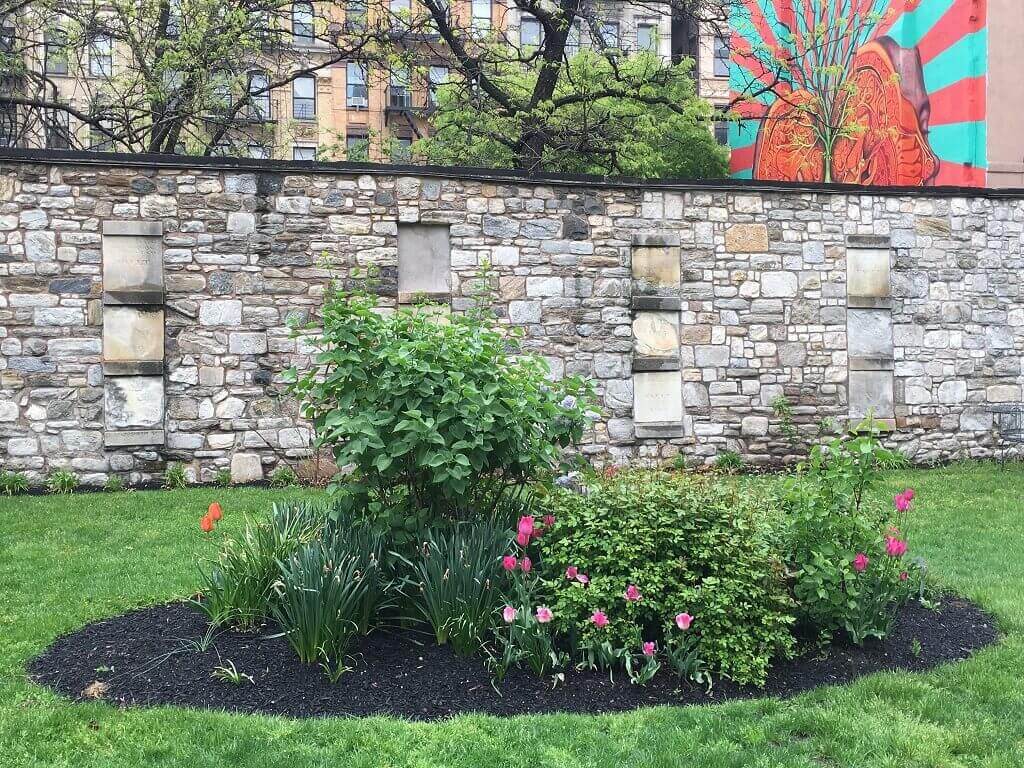
Rather than standard earth graves, 156 marble vaults were built ten feet underground beneath the lawn, with marble plaques set into the surrounding walls identifying the families interred below.
This design came about because legislation at the time had outlawed earth graves in response to yellow fever outbreaks.
The cemetery is only open to the public a handful of times each year, which is part of what makes visits feel genuinely special.
Check marblecemetery.org for the current schedule of open days before you plan your visit.
16. Catacombs of the Basilica of Saint Patrick’s Old Cathedral
Catacombs in New York City?! Yes!
The Catacombs of the Basilica of Saint Patrick’s Old Cathedral in New York City are one of the most fascinating historic burial sites in the United States and certainly one of the most underrated places in NYC.
Located beneath the original St. Patrick’s Cathedral in Lower Manhattan, the catacombs were constructed shortly after the church opened in 1815.
The basilica served as the first cathedral of the Roman Catholic Diocese of New York and played a central role in the growth of Catholicism in the city.
The underground crypts contain more than 50 burial vaults and family tombs, preserving the remains of prominent New Yorkers from the nineteenth and early twentieth centuries.
Among the notable individuals buried there are members of the famous Delmonico family, founders of Delmonico’s Restaurant in lower Manhattan.
Today, visitors can enter the catacombs and take candlelight tours explaining the history of the basilica and New York City itself.

17. Where to Stay in New York City
You want a mid-range hotel but it’s too far from what you want to see in NYC. Or you want to stay near a friend on the Upper East Side but but the museum you want to visit is all the way downtown.
Here is the answer to your accommodation needs in New York City. Where to stay in New York City based on what you want to do and see.
Making the Most of Your Time in New York
The thing about NYC is that it never runs out of surprises. You can visit the same neighborhood ten times and still find something you missed on every previous trip.
That is what makes it different from almost anywhere else. But it also means that if you stick to the usual tourist circuit, you will leave having seen only a fraction of what the city actually has to offer and you will miss the most underrated places in NYC.
Every place on this list can be reached by subway, and most of them cost little or nothing to visit.
None of them will have the crowds you deal with at the Statue of Liberty or the top of the Rockefeller Center.
What they will have is the kind of quiet, genuine experience that tends to stay with you long after you have forgotten the selfie you took at Times Square.
If you are planning a trip to New York, try to work at least two or three of these into your itinerary.
If you live here and have not been to some of them yet, that is even more reason to go.
The city has a way of feeling brand-new again when you start paying attention to the parts most people walk right past.
“Every true New Yorker believes with all his heart that when a New Yorker is tired of New York, he is tired of life.” ― Robert Moses Share on XFinal Words on The Most Underrated Places in NYC, The New York You Don’t See in Guidebooks
New York City rewards people who are willing to go a little further, look a little closer, and step off the path everyone else is on.
Every single place on this list offers something you simply will not find at the big-name attractions, and none of them will have the same crowds you would deal with at the top of the Empire State Building.
Have you been to any of these hidden spots? Or do you know of one of the most underrated places in NYC you want to share? Drop it in the comments below!


Can’t get enough of New York City? Check out these other posts with even more NYC secrets.
21 Unique things to do in NYC you just can’t do anywhere else.
26 authentic ethnic restaurants in New York City: From A to Z.
10 Coolest neighborhoods in Manhattan.
18 famous places to eat in New York City without going broke.
Coolest things to do in Harlem.
Beautiful places to visit in Central Park, NYC – with map!
What to do in NYC for the winter holidays.
Where to stay in New York City based on what you want to see and do.
What do you think are the most underrated attractions in NYC? We’d like to know.

PIN ME TO
PINTEREST!

BTW, if you are getting ready for your trip, make sure to take advantage of these useful, money-saving links to book your trip:
- Research and book your flight with Skyscanner. I have found them to be the best because they list all airlines including the budget ones. You are always sure of having researched all options.
- For car rental around the world, Discover Cars has flexible pickup and drop-off options, I recommend Discover Cars.
- Book your accommodation with Booking.com. I find they have a wide selection and a nice, user-friendly, transparent website.
- Protect your trip and, more importantly, protect yourself with travel insurance. I use Travelinsurance.com and have been very happy with them.
- For more general tours to any destination or attraction, book with Viator. Check them out.
- Need a visa? Get your visa for all countries with Passport Visa Express.
- Looking for a cool walking tour to explore a city? My favorite walking tours are offered by Take Walks.
- Food and drink tours are the best way to enjoy a city. And Devour Tours are my favorite.
- Looking for a good VPN to protect your security, privacy and freedom online while traveling? Nordvpn is your best option.
- The best and most economical way to stay connected while traveling is with an Airalo eSIM.
I personally use, and can recommend, all the companies listed here and elsewhere on my blog. By booking through these sites, the small commission we earn – at no cost to you – helps us maintain this site so we can continue to offer our readers valuable travel tips and advice.









4 Responses
Nice selection here. Some of these I haven’t been to. But proud to say I have done quite a few already. Two of them (Transit Museum and Roosevelt Island) even during my first ever visit to NYC. By now I’ve been quite a few times and love exploring new things. So will check out a few more of your suggestions next time I visit New York (for sure finally need to go and explore The Cloisters).
Thank you for reading and commenting. Yes, the Cloisters is a must. You will love it.
I love the Highline and the Frick Collection,in particular. I will try more of these on future trips. Thank you!
I love so many things in this wonderful city. My beautiful home town.