
Every year, thousands of travelers prepare for the Camino and lace up their boots, sling on a backpack, and set out across Spain on one of the most rewarding journeys a person can take on foot.
This guide covers all you need to prepare for the Camino: footwear, packing, accommodations, pre-trip logistics, route planning, and more.
The Camino de Santiago walk isn’t just a hike — it’s a centuries-old pilgrimage route that winds through vineyards, mountain passes, medieval villages, and quiet forest trails, all leading to the magnificent Cathedral of Santiago de Compostela.

I walked the shorter Camino from Sarria to Santiago to experience the route’s natural beauty. Perhaps you’re drawn to it for spiritual reasons.
Maybe you crave the physical challenge. Or could it be you simply relish the chance to disconnect from daily life and reconnect with yourself.
Whatever your motivation, walking the Camino de Santiago is an experience that stays with you long after your boots come off.
But make sure you prepare for the Camino properly to maximize your experience. And always get tips from people who have actually walked the route.
What Exactly is the Camino?
The Camino de Santiago isn’t a single trail — it’s a network of historic pilgrimage routes that all converge on Santiago de Compostela in northwestern Spain.
The legend is that the remains of the apostle Saint James are buried in the cathedral. You can visit the tomb.
The most popular route, the Camino Francés (French Way), stretches roughly 780 kilometers from Saint-Jean-Pied-de-Port in France to Santiago.
This route typically takes pilgrims (the folks who take the walk) four to five weeks to complete.
Other popular options include the Camino Portugués, which runs up from Lisbon or Porto, and the Camino del Norte, which hugs Spain’s dramatic northern coastline.
Many pilgrims or walkers choose to complete just a portion of a route rather than the entire thing. In fact, if you want to receive the official Compostela certificate in Santiago, you only need to walk the final 100 kilometers (or cycle the last 200 kilometers).

Other options are to walk a portion of the route, then return at a later date to walk another portion or complete the walk entirely.
This flexibility is part of what makes the Camino so appealing — you can shape the experience around the time and stamina you have available.
Choosing the Right Time to Walk the Camino de Santiago
Timing matters a lot. Late spring (May and June) and early autumn (September and October) are widely considered the perfect times to walk the Camino.
The weather is mild, the daylight hours are long, and the summer crowds haven’t arrived yet.
July and August bring intense heat, especially across the meseta — the flat, exposed plateau in the middle of the Camino Francés — along with fully booked albergues (pilgrim hostels) in peak season.
Winter walking is possible on some routes but comes with real challenges: shorter daylight, closed accommodations in smaller villages, and snow at higher elevations like the Pyrenees crossing near Roncesvalles.
If you’re set on a winter walk, do extra research on which albergues stay open and always carry a backup accommodation plan. But do try to walk the Camino at optimum times.
How to Prepare for the Camino Physically
You don’t need to be an elite athlete to walk the Camino. I certainly am not, but I walked the Camino comfortably in May. But you do need to prepare your body for consecutive days of walking, often covering 20 to 25 kilometers a day with a loaded pack.
The single biggest mistake new pilgrims make is underestimating the cumulative toll of walking day after day without rest. But keep in mind, you can take as much or as little time as you want to walk the Camino.
To best prepare for the Camino, start training at least two to three months before departure. Begin with shorter walks of 5 to 8 kilometers a few times a week, gradually building distance until you’re comfortable covering 15 to 20 kilometers in a single outing.
Try to walk on varied terrain — pavement, gravel, hills — since the Camino includes everything from smooth farm roads to rocky mountain ascents and descents to medieval towns.


It’s also worth training with the actual backpack you plan to carry, loaded to roughly the weight you’ll bring, so your shoulders, hips, and feet adjust to the real conditions ahead of time.
Strength training matters too. Focus on your core, glutes, and legs, since these muscle groups absorb most of the impact from long-distance walking.
Simple exercises like squats, lunges, and calf raises two or three times a week can meaningfully reduce your risk of injury on the trail.
The Key to a Successful Camino Walk – Footwear!
If there’s one gear decision that can make or break your Camino walk, it’s your footwear. Blisters are the most common reason pilgrims struggle or drop out early. And I’m not exaggerating!
The single best way to prepare for the Camino is to choose trail shoes or lightweight hiking boots that fit properly with room in the toe box. And break them in thoroughly! — ideally over many days and 100 kilometers of walking — before your trip begins.
It goes without saying, never start a long-distance walk in brand-new shoes.
Many experienced Camino walkers prefer trail runners or sturdy sneakers/trainers over heavier hiking boots, since they’re lighter and dry faster after rain. This was my preference as well.
This really matters on routes like the Camino del Norte or during wetter months in Galicia, Spain’s wettest province.
Whatever you choose, pack two pairs of well-fitted merino wool socks and rotate them daily. You may also want to consider a second pair of lightweight sandals or shoes to wear in the evenings so your feet can recover.
Eating on the Camino
You are in Spain, so there’s that. It’s really almost impossible to get a bad meal. Food on the Camino is as delightful as it is anywhere else in Spain. This is the perfect opportunity to explore the regional cuisine of northern Spain.
Northern Spain, especially Galicia, is famous for seafood. Try the local specialty, octopus Galician style with a cold beer or one of the local wines.
And talk about local wines! I was astounded when I tasted “Godello” wine for the first time in a little plaza cafe.
It soon became my favorite wine, followed closely by the Galician Albariño. Fortunately, it is now widely available outside of Spain.
The northern region of Spain has some of the best wines in the country, particularly those from the Rías Baixas Region.

Packing Light: Only What You Actually Need
Overpacking is the second most common mistake after undertrained feet. A general rule among pilgrims is to keep your pack weight to no more than 10 percent of your body weight.
As an over-50 woman traveler walking the Camino, these are some of my top packing tips.
For preparing for the Camino specifically, here’s a realistic list of essentials:
- A well-fitted backpack (30–40L) with a supportive hip belt
- A lightweight, packable rain jacket
- Two pairs of hiking socks plus liner socks if prone to blisters
- A refillable water bottle or hydration bladder
- A lightweight sleeping bag liner for albergues
- If you’re super motivated, a headlamp for early starts
- A phone with a Camino app for navigation and albergue listings
- Two to three moisture-wicking shirts and one warmer layer
- A basic first-aid kit with blister treatment, tape, and pain relief
Planning Your General Route and Daily Stages
Before you start on your Camino walk, map out a rough daily itinerary. Even if you plan to stay flexible once you’re walking, having this rough itinerary is a smart way to prepare for the Camino.
Most guidebooks and apps break the Camino Francés into standard stages of 20 to 30 kilometers between towns with accommodation.
First-timers frequently plan shorter days for the first week, since your body needs time to adjust to the rhythm of walking, eating, and sleeping in a new place every night. Then they slowly increase the walking time.
Decide in advance whether you’ll book accommodations ahead or rely on the traditional “walk and find a bed” approach.
I used a service that booked accommodations for us ahead of time. I stayed in nice, regional hotels accustomed to serving the pilgrim community.
Municipal albergues are city-run hostel-style accommodations that operate on a first-come, first-served basis and can’t be reserved.
Private albergues and small hotels often can be booked a day or two ahead — useful during busy months or if you have any physical limitations that make flexibility riskier.
I understand the algergues are clean, reasonably priced, and quite fit for purpose. Many even have private bathrooms.
If you are willing to splurge and really dive into the historical hotels on the Camino, consider the Paradores of Spain. These are state owned, privately run hotels that are usually housed in converted historical buildings like monasteries, abbeys, castles, convents and ancient manor houses.
These can be found all over Spain and there are a few on the Camino. One of the most historical and beautiful is the Parador de Santiago Hostai Reis Catolicos or Catholic Monarchs. It might just be the best parador in Spain.
It is housed in a converted hospital inaugurated by Queen Isabela of Spain and is right smack in the center of town. Staying here is the experience of a lifetime.


Practical Logistics Before You Leave
These pre-walk logistical details are easy to overlook but important to address before departure:
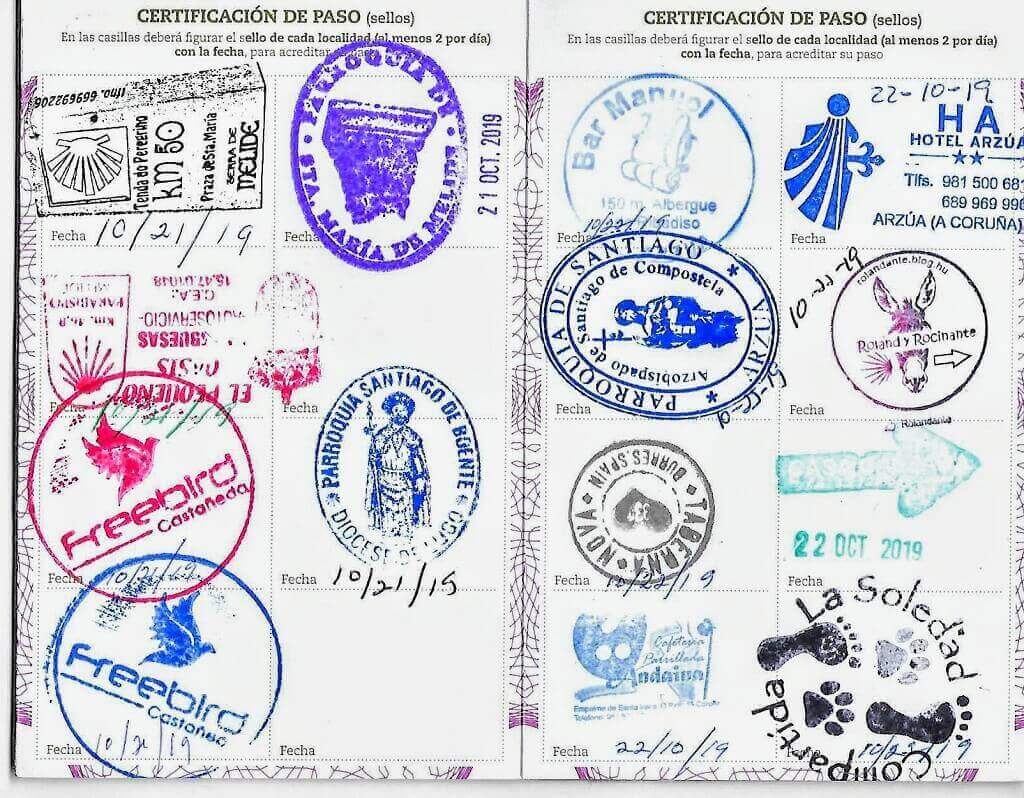
- Get a pilgrim credential (Credencial del Peregrino or Pilgrim’s credential): This passport-style document gets stamped at albergues, cafés, and even on road stands along the way and is required to receive your Compostela certificate in Santiago.
You can get this just about anywhere: the hotel, alberque, tourist information center, some cafes. Below you see what a credencial looks like and a roadside stand where you can get a stamp. Shoot for 2 stamps a day, if possible.

- Check passport and visa requirements: Depending on your nationality, you may need a Schengen visa to enter Spain.
- Arrange travel insurance: Look for a policy that covers trip interruption and medical evacuation, since injuries do happen on the trail. For travel insurance, I like this site that lets you compare policies based on your specific characteristics.
This post details information on travel insurance for the over-50 woman traveler.
- Learn a few basic Spanish phrases: English is spoken in many albergues, but another good way to prepare for the Camino is to learn a little Spanish. This goes a long way in smaller villages.
- Notify your bank: Let your bank know you’ll be traveling to avoid card blocks in rural Spain.
Final Thoughts Based on My Own Personal Experience
Go on your Camino walk with realistic expectations. Some days will simply be about putting one foot in front of the other through rain or heat.
Allow yourself time to rest when you need to. Slowing down or adjusting your plan isn’t failure; it’s just adjustment. Resist the temptation to call a taxi.

It’s common to move through waves of excitement, boredom, frustration, and unexpected joy — sometimes all in the same day.
Train steadily, break in your shoes, pack light and be kind to yourself while on the Camino. Prepare for the Camino well, but leave room for the unexpected. That’s often where the best parts of the journey happen.
If you’re still finalizing your plans, working with a travel specialist familiar with the Camino routes can take the guesswork out of logistics. That’s what I did.
They’ll help you choose the right accommodation, starting point and other details you’d rather not research yourself.
Frequently Asked Questions
How many days does it take to walk the Camino de Santiago?
The full Camino Francés takes most walkers four to five weeks, covering roughly 20–25 kilometers per day.
Shorter routes, like the last 100 kilometers from Sarria, can be completed in about five to seven days. I walked the Camino from Sarria to Santiago — the shortest route — in 6 days at a comfortable pace.
Do I need to be extremely fit to walk the Camino?
No, not at all. But you should train beforehand. Most healthy adults who build up their walking distance over a couple of months can complete the Camino comfortably, at their own pace.
What is the best time of year to walk the Camino?
Ideally, prepare for the Camino in late spring (May–June) and early fall (September–October), which offer the best balance of good weather, manageable crowds, and available accommodations.
How much does it cost to walk the Camino de Santiago?
Budget travelers often spend €30–€40 per day covering albergue stays and simple meals. If you prefer something a little more upscale, budget €60–€100 or more per day.
Do I need to carry my own backpack the whole way?
Not necessarily. Luggage transfer services operate along the popular routes, moving your main bag from town to town each day so you can walk with just a light daypack if you prefer.
That’s what I did. The service took my luggage in the morning and delivered it to the next accommodation by 5 PM. It all worked very well and I only had to carry a light backpack, making the journey infinitely easier and more pleasant.
Is it safe to walk the Camino alone?
Yes, the Camino is considered one of the safest long-distance trails in the world, and solo travelers — including many women — walk it regularly. The route is well-marked with guideposts and signs throughout. It is well-traveled with a strong sense of community among pilgrims.
Want to know more about this ancient route and how to prepare for the Camino? Check out these handy reference guides.


What are your thoughts on how to prepare for the Camino? Do you have other suggestions? Let us know in the comments.


BTW, if you are getting ready for your trip, make sure to take advantage of these useful, money-saving links to book your trip:
- Research and book your flight with Skyscanner. I have found them to be the best because they list all airlines including the budget ones. You are always sure of having researched all options.
- For car rental around the world, Discover Cars has flexible pickup and drop-off options, I recommend Discover Cars.
- Book your accommodation with Booking.com. I find they have a wide selection and a nice, user-friendly, transparent website.
- Protect your trip and, more importantly, protect yourself with travel insurance. I use Travelinsurance.com and have been very happy with them.
- For more general tours to any destination or attraction, book with Viator. Check them out.
- Need a visa? Get your visa for all countries with Passport Visa Express.
- Looking for a cool walking tour to explore a city? My favorite walking tours are offered by Take Walks.
- Food and drink tours are the best way to enjoy a city. And Devour Tours are my favorite.
- Looking for a good VPN to protect your security, privacy and freedom online while traveling? Nordvpn is your best option.
- The best and most economical way to stay connected while traveling is with an Airalo eSIM.
I personally use, and can recommend, all the companies listed here and elsewhere on my blog. By booking through these sites, the small commission we earn – at no cost to you – helps us maintain this site so we can continue to offer our readers valuable travel tips and advice.